

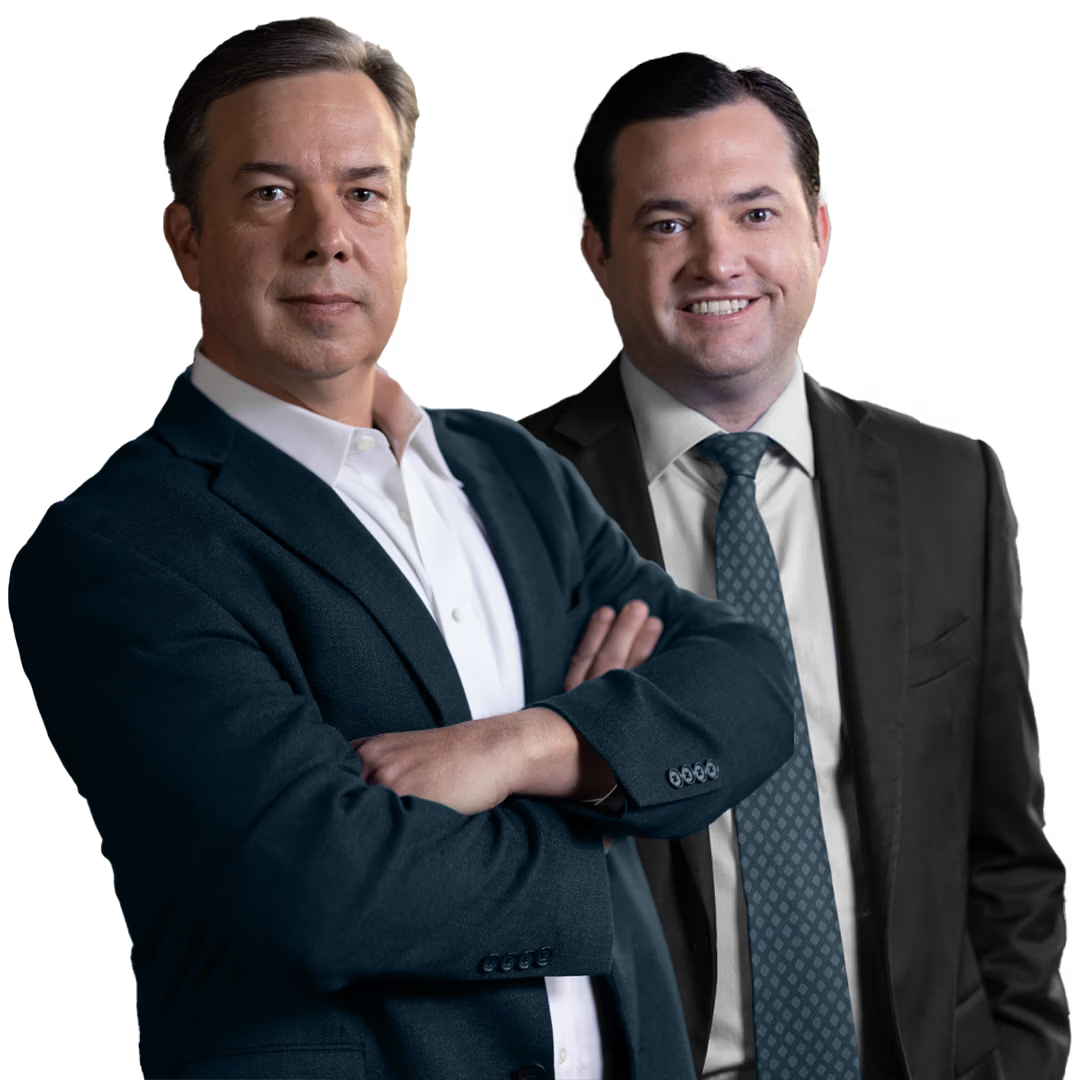
No one researches personal injury attorneys for fun. Something happened, and now you need to understand your options under Texas law.
This page explains how Texas personal injury cases work, what rules apply in Tarrant County, and what to look for when choosing a lawyer. Morris & Dewett has represented injured clients in Texas for over 25 years. Take your time. Do your research. Reach out when you're ready.
Texas Personal Injury Law: What Fort Worth Residents Need to Know
Texas gives injured people two years to file a personal injury lawsuit. That deadline is set by CPRC Section 16.003(a) and runs from the date of injury, not the date you discover the full extent of your injuries. Two years sounds like a long time. It is not, once you account for investigation, evidence collection, and the time it takes to reach MMI.
Texas uses proportionate responsibility to allocate fault among parties. Under CPRC Section 33.001, a claimant who is 51% or more at fault recovers nothing. At exactly 50%, you can still recover, but your damages are reduced by 50%. Insurance adjusters understand this rule well. Their strategy often focuses on pushing your assigned fault above 50%.
Ask any attorney you talk to: how do they document and defend fault allocation before an insurer builds their narrative? Evidence gathered in the first 48 to 72 hours after a crash matters most. Morris & Dewett works with accident reconstructionists and begins evidence preservation immediately.
To bring a successful personal injury claim in Texas, you must prove four elements: the defendant owed you a duty of care, the defendant breached that duty, the breach caused your injury, and you suffered compensable damages. All four elements must be proven by a preponderance of the evidence.
Damages in Texas personal injury cases fall into three categories. Economic damages are measurable: past and future medical expenses, lost wages, reduced earning capacity, and property damage. Non-economic damages compensate for pain and suffering, mental anguish, physical impairment, and disfigurement. These are real losses without a receipt. Exemplary damages are available in cases involving malice, fraud, or gross negligence, subject to statutory caps under CPRC Section 41.008.
Texas does not allow direct action against an at-fault driver's insurer. You sue the person or company that caused the injury. The insurer defends and pays any judgment, but is not a named defendant.
Auto Insurance Minimums and UM/UIM in Texas
Texas requires every driver to carry minimum auto liability coverage of 30/60/25 under Tex. Transp. Code Section 601.072. That is $30,000 per injured person, $60,000 per accident for bodily injury, and $25,000 for property damage. These minimums have not kept pace with the actual cost of serious injuries.
When the at-fault driver carries only minimum coverage, the gap between their policy limit and your actual damages becomes your problem, unless you have UM/UIM. Under Tex. Ins. Code Chapter 1952, Texas insurers must offer UM/UIM coverage with every policy. If you did not reject it in writing, you likely have it.
The Stowers doctrine creates insurer accountability in Texas. Three elements must exist: the demand must be within policy limits, the claim must be within coverage scope, and a reasonable insurer would accept it. When those elements exist, an insurer that refuses faces exposure for the entire verdict.
Ask any attorney you are considering: have they sent Stowers demands and used insurer excess-judgment exposure as a negotiating tool? An attorney who has not used this doctrine is leaving leverage on the table.
For practice area detail, see our pages on car accidents, motorcycle accidents, and truck accidents.
Where Are Personal Injury Cases Filed in Tarrant County?
Personal injury cases against Texas defendants in Fort Worth are filed in Tarrant County District Courts, located at the Tim Curry Justice Center. Multiple district courts have civil jurisdiction, including the 96th, 141st, 153rd, 236th, 342nd, 348th, 352nd, and 360th District Courts.
Appeals from Tarrant County go to the 2nd Court of Appeals, located in Fort Worth. Federal civil rights or diversity jurisdiction cases may be heard by the Northern District of Texas, Fort Worth Division.
Venue matters. Where you file affects which judge and which jury pool hears your case. Tarrant County's jury pool demographics, local judicial temperament, and prior verdicts in similar cases all factor into litigation strategy. Ask any attorney you talk to whether they have tried cases in Tarrant County courts, not just settled them.
Morris & Dewett has appeared in Texas courts throughout our 25-plus years of practice. We know which venues present specific challenges for injury plaintiffs and how to prepare for them.
JPS Health Network and Fort Worth Trauma Care
JPS Health Network is the Level I trauma center serving Tarrant County. Level I designation means JPS maintains 24/7 readiness for the most severe injuries: penetrating trauma, polytrauma, spinal cord injuries, and traumatic brain injuries. Not every hospital in the DFW area carries this designation.
Level I centers treat more severe cases and produce more detailed records. The treating physicians, specialists, and records from JPS become critical evidence in serious injury litigation. Your attorney should understand how to work with JPS physicians, how to request complete record sets, and how to coordinate with treating specialists as expert witnesses.
For injured children, Cook Children's Medical Center handles pediatric trauma in the DFW area. Pediatric injury cases present distinct challenges, including calculating lifetime economic damages for a child and managing guardianship issues in litigation.
Ask any attorney: who handles medical record acquisition, physician coordination, and expert witness retention on injury cases? In a firm where attorneys do their own medical work, you will get less of both legal strategy and medical thoroughness.
Fort Worth Practice Areas
Morris & Dewett handles the full range of personal injury cases in the Fort Worth and DFW Metroplex area. Practice area pages are listed below with route-specific detail.
Car Accidents -- The I-30, I-35W, I-20, Loop 820, and SH-121 corridors produce the highest crash volumes in Tarrant County. Intersection accidents are common in commercial zones along Camp Bowie Boulevard and North Tarrant Parkway.
Truck Accidents -- I-20 and I-35W carry significant commercial truck volume. FMCSA hours-of-service, ELD records, and post-crash inspection reports create evidence that does not exist in passenger car cases. The Alliance Airport corridor north of Fort Worth is one of the most active logistics zones in the DFW region.
Motorcycle Accidents -- Texas requires helmets only for riders under 21, unless the rider has completed a safety course or carries at least $10,000 in first-party medical coverage. Helmet non-use does not bar recovery but may affect damages arguments.
Bus Accidents -- Claims against government-operated transit systems (such as the Trinity Metro bus system) require attention to government claims notice requirements.
Wrongful Death -- Texas limits wrongful death claimants to surviving spouses, children (including adopted), and parents (natural or adoptive only).
Catastrophic Injuries -- Brain trauma, spinal trauma, and severe burns require lifetime cost projections from vocational economists and life-care planners.
Construction Site Accidents -- OSHA standards apply to construction sites. Third-party liability may exist alongside or instead of workers' compensation claims.
Workers Compensation -- Texas non-subscriber cases are handled separately from comp claims.
Offshore Accidents -- Maritime law may apply to workers injured on navigable waters.
Pedestrian accidents in Fort Worth most often occur in high-density pedestrian zones: downtown, the Near Southside, TCU-area streets, and along major commercial corridors. Texas Transportation Code governs crosswalk and right-of-way rules. Comparative fault disputes are common when a pedestrian was not in a marked crosswalk.
Premises liability cases in Texas turn on the visitor's legal status. An invitee receives the highest protection. A licensee receives less. A trespasser receives almost none, with limited exceptions for children under the attractive nuisance doctrine.
Rideshare accidents through Uber or Lyft involve a coverage gap that standard auto insurance does not address. When a TNC driver is waiting for a ride request (app on, no passenger), coverage is limited. When actively transporting a passenger, full TNC coverage applies. The gap between personal and TNC policy coverage depends on exactly what the driver was doing at the time of the crash.
Dog bite liability in Texas requires proving the owner knew or should have known of the animal's dangerous propensity. Texas does not have a strict liability dog bite statute. This is sometimes called the "one bite rule," though it is more accurately a knowledge-of-dangerous-propensity standard.
Texas Workers Compensation: The Non-Subscriber System
Texas is the only state where private employers can legally opt out of workers' compensation coverage, under Tex. Labor Code Section 406.002. Whether your employer subscribed or opted out determines whether you file a comp claim or a civil lawsuit.
Subscribing employers carry workers' comp coverage and receive exclusive remedy protection. You cannot sue a subscribing employer in civil court, regardless of how negligent they were. Non-subscribing employers opt out and pay for injuries through other means, but they forfeit three key legal defenses in any civil lawsuit: contributory negligence, assumption of risk, and the fellow servant doctrine.
The practical effect is significant. A non-subscriber's employee only needs to prove the employer was negligent. The employer cannot deflect blame to the employee or to coworkers. Large employers in Fort Worth's construction sector, warehousing, and logistics frequently opt out. The Alliance Airport logistics corridor includes some of the largest non-subscriber employers in North Texas.
Ask any attorney you consider: how quickly can they determine whether your employer is a subscriber or non-subscriber? If they do not have an immediate answer, they lack experience with Texas workers' compensation cases.
The Stowers Doctrine: Texas Insurer Accountability
Texas common law created the Stowers doctrine before most modern insurance statutes existed. It holds insurers to a specific standard in settlement negotiations. When a plaintiff makes a demand within policy limits, the claim is within coverage, and a reasonable insurer would accept, the insurer must either pay or accept the risk of a larger verdict.
If the insurer declines a qualifying demand and the jury returns a verdict above the policy limits, the insurer pays the entire judgment, not just the policy amount. This exposure is separate from first-party bad faith claims, which arise under Tex. Ins. Code Chapter 541 in a different context.
Stowers creates leverage in cases with clear liability and strong damages. An experienced plaintiff's attorney uses the doctrine as a settlement tool before trial, not just as a remedy after a verdict.
Ask any attorney you are considering: have they used Stowers demand letters as a negotiating strategy? What happened? An attorney who cannot answer this question in specific terms has not handled cases where it was relevant.
Fort Worth Major Roads and Crash Corridors
Fort Worth sits at the center of the DFW Metroplex road network. I-30 runs east-west through downtown. I-35W runs north-south and splits from I-35E in the city, carrying heavy commercial truck traffic toward the Alliance Airport logistics corridor. I-20 runs east-west along the southern edge, connecting the DFW area to West Texas and beyond with consistent commercial volume.
Loop 820 encircles inner Fort Worth and contains multiple high-volume interchange areas prone to rear-end and lane-change crashes. SH-121 connects Tarrant County to Denton, Collin, and Dallas Counties and carries high-speed commuter traffic that produces serious-injury crashes.
The Alliance Airport area in north Fort Worth is one of the most concentrated commercial vehicle zones in North Texas. Warehouse and distribution operations, cross-dock facilities, and industrial parks generate daily truck traffic on SH-170 and Alliance Gateway Freeway.
Crash corridor knowledge matters for evidence collection. Surveillance cameras, traffic control systems, and commercial vehicle dash cams are most prevalent on major corridors. Acting quickly after a crash on these roads can preserve video evidence before it overwrites.
See the dangerous Texas highways blog post for additional context on Texas road risk data.
Wrongful Death in Texas
Texas wrongful death law is narrower than most people expect. Under CPRC Chapter 71, only three categories of family members may bring a wrongful death claim: the surviving spouse, surviving children (including adopted children), and surviving parents (natural or adoptive only). Siblings, grandchildren, stepparents who did not legally adopt, and divorced spouses cannot file.
This limitation creates gaps. If the deceased had no spouse, children, or living parents, no wrongful death claim exists even if the death was clearly someone else's fault. If no qualifying family member files within three months, the executor or administrator of the estate must bring the action.
The survival action under Section 71.021 runs parallel to wrongful death. It recovers the decedent's own losses: pain and suffering between injury and death, pre-death medical expenses, and lost earnings. The two claims are separate. Both can be filed simultaneously. Both carry a two-year statute of limitations from the date of death.
Morris & Dewett has handled wrongful death litigation in Texas courts. These cases require building a complete factual record under tight timelines while coordinating with families during an extremely difficult period.
Ask any attorney you consider for a wrongful death case: have they taken wrongful death cases to verdict in Texas, or only settled them? What is their approach to the survival action alongside the wrongful death claim?
For practice-area detail, see wrongful death.
Frequently Asked Questions
- How long do I have to file a personal injury lawsuit in Fort Worth, Texas?
-
Texas law gives you two years from the date of injury to file a personal injury lawsuit under [CPRC Section 16.003(a)](https://statutes.capitol.texas.gov/Docs/CP/htm/CP.16.htm). Missing that deadline ends your right to recover, with very limited exceptions for minors and persons of unsound mind. Wrongful death claims also carry a two-year deadline, running from the date of death under Section 16.003(b).
- What does proportionate responsibility mean in a Texas car accident case?
-
Texas uses proportionate responsibility under [CPRC Chapter 33](https://statutes.capitol.texas.gov/Docs/CP/htm/CP.33.htm). If you are 51% or more at fault for the accident, you cannot recover any damages. If you are 50% or less at fault, your recovery is reduced by your fault percentage. For example, if you are found 20% at fault and your damages are $100,000, you recover $80,000. Insurance companies often try to assign fault above 50% to eliminate recovery entirely.
- Can I sue the at-fault driver's insurance company directly in Texas?
-
No. Texas does not allow direct action against the at-fault driver's liability insurer. You file suit against the driver or other responsible party. The insurer defends and pays any judgment up to policy limits, but is not a named defendant in the lawsuit. This is a significant difference from states that allow direct action.
- What is the Stowers doctrine and how does it affect my case?
-
The Stowers doctrine is a Texas common law rule requiring liability insurers to accept a reasonable settlement demand within policy limits. If the insurer refuses a qualifying demand and the jury returns a verdict above the limits, the insurer pays the full judgment, not just the policy amount. This creates real leverage for plaintiffs with strong liability cases. An attorney must send the demand properly to trigger Stowers exposure.
- What if my employer does not carry workers' compensation insurance in Texas?
-
Texas employers can legally opt out of the workers' compensation system under [Tex. Labor Code Section 406.002](https://statutes.capitol.texas.gov/Docs/LA/htm/LA.406.htm). If your employer is a non-subscriber and you are injured, you can sue them in civil court for negligence. Non-subscribers cannot raise contributory negligence, assumption of risk, or the fellow servant doctrine as defenses. This makes non-subscriber cases significantly more favorable for injured workers than standard comp claims.
- Who can file a wrongful death lawsuit in Texas?
-
Texas limits wrongful death claimants to three categories: the surviving spouse, surviving children (including adopted children), and surviving parents (natural or adoptive only). Siblings, grandchildren, divorced spouses, and stepparents without legal adoption cannot file under [CPRC Chapter 71](https://statutes.capitol.texas.gov/Docs/CP/htm/CP.71.htm). If no eligible family member files within three months of the death, the estate's executor or administrator must bring the action.
- What are the minimum auto insurance limits in Texas?
-
Texas requires minimum liability coverage of 30/60/25 under [Tex. Transp. Code Section 601.072](https://statutes.capitol.texas.gov/Docs/TN/htm/TN.601.htm): $30,000 per person for bodily injury, $60,000 per accident for bodily injury, and $25,000 for property damage. These minimums frequently do not cover the full cost of serious injuries. UM/UIM coverage on your own policy fills the gap when the at-fault driver's limits are insufficient.
- Which hospital handles severe trauma cases in Fort Worth?
-
[JPS Health Network](https://www.jpshealthnet.org/) holds the Level I trauma center designation for Tarrant County. Level I status means JPS provides 24/7 surgical, neurosurgical, and critical care capacity for the most severe injuries. For pediatric trauma, [Cook Children's Medical Center](https://www.cookchildrens.org/) serves the DFW area. The treating hospital's records and specialist physicians become key evidence in serious injury cases.
- What courts handle personal injury cases in Tarrant County?
-
Tarrant County District Courts have jurisdiction over civil personal injury cases. Multiple courts handle this docket, including the 96th, 141st, 153rd, 236th, 342nd, 348th, 352nd, and 360th District Courts. Appeals from these courts go to the [2nd Court of Appeals](https://www.txcourts.gov/2ndcoa/) in Fort Worth. Federal cases involving Texas defendants may go to the [Northern District of Texas, Fort Worth Division](https://www.txnd.uscourts.gov/).
- Do I have a valid personal injury case in Texas?
-
A valid personal injury claim in Texas requires four elements: the defendant owed you a duty of care, the defendant breached that duty, the breach caused your specific injury, and you suffered measurable damages as a result. Meeting all four elements does not guarantee recovery, but a case missing any one element cannot proceed. An attorney can evaluate these elements against the facts of your situation in a consultation.
- How much is my personal injury case worth in Texas?
-
Texas personal injury case value depends on economic damages (documented medical bills, lost wages, reduced future earning capacity, property damage), non-economic damages (pain, suffering, mental anguish, disfigurement), and the at-fault party's available insurance coverage. Exemplary damages under CPRC Section 41.008 may apply when gross negligence, malice, or fraud is involved. There is no standard formula. Case value requires evaluating the specific injury, the evidence, and the applicable insurance coverage available. Morris & Dewett evaluates each case individually. View our [case results](/case-results/) for examples of prior outcomes.
- What should I do immediately after an accident in Fort Worth?
-
Call 911 if there are injuries or if vehicles cannot be moved. Get a copy of the crash report from the investigating officer. See a doctor or go to an emergency room even if symptoms seem minor. Do not give recorded statements to anyone's insurance company before consulting an attorney. Preserve any photos, video, or witness contact information from the scene. The first 72 hours after an accident produce evidence that cannot be recovered later, including surveillance footage that overwrites, witness memories, and vehicle inspection data.
These answers reflect Louisiana law as of . For case specific advice, consult with a Louisiana personal injury attorney who can evaluate your particular circumstances.