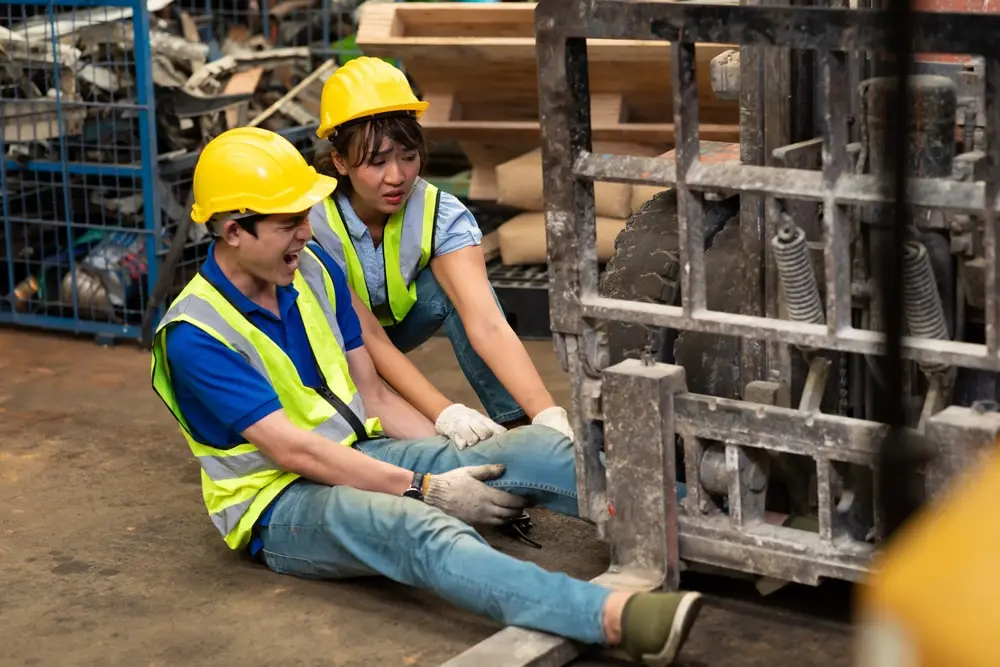
Industrial work in Louisiana carries real risk. Chemical plants, refineries, manufacturing facilities, and construction sites all present hazards that can cause serious injury. No one researches industrial injury lawyers for fun. Something happened, and you need answers.
This page explains what industrial injury claims involve in Louisiana, how the 2024 and 2025 law changes affect your case, and when you should talk to an attorney. Morris & Dewett has handled industrial injury cases for over 25 years. Read through it. Compare us to other firms. Reach out when you're ready.
We only accept real cases with real injuries.
What Is an Industrial Injury?
An industrial injury is job-related physical trauma you suffer while working in industrial occupations. These jobs typically involve manual labor and include workers like:
- Manufacturing workers
- Construction workers
- Oil and gas industry workers
- Transportation and logistics workers
- Warehouse workers
- Refinery and plant workers
- Offshore workers
Many industrial accidents cause minor injuries. The worst cause catastrophic injury, sometimes with dozens of workers hurt in a single incident. Serious accidents tend to cause injuries like:
- Amputations: Loss of limbs from equipment accidents or crushing injuries.
- Severe Burns: Chemical, thermal, or electrical burns from industrial processes.
- Spinal Cord Damage: Falls and equipment accidents can cause paralysis or chronic pain.
- Traumatic Brain Injuries: Struck-by accidents and falls frequently cause serious head trauma.
- Crushing Injuries: Heavy equipment and machinery create risks for compression injuries.
- Internal Injuries: Blunt force trauma from industrial accidents can damage internal organs.
- Wrongful Death: The most serious industrial accidents claim workers' lives.
What Causes Industrial Injuries & Death?
Lax safety protocols, training failures, and company culture contribute to industrial accidents. Most cases involve avoidable negligence and at least one of the top safety violations identified by OSHA. These violations matter because they establish that your employer knew what the safety standards were and failed to follow them:
- Fall protection violations: Employers must provide guardrails, safety nets, or personal fall arrest systems when workers operate at heights of six feet or more. Missing or inadequate fall protection is the most cited OSHA violation every year.
- Hazard communication failures: Workers have a right to know what chemicals they handle. Employers must maintain safety data sheets, label containers, and train workers on chemical hazards in the workplace.
- Ladder safety violations: Ladders must be inspected, rated for the load, and positioned correctly. Workers are injured when employers provide damaged ladders or fail to train on proper setup and use.
- Scaffolding hazards: Scaffolds must be built on stable ground, fully planked, and equipped with guardrails. Improperly erected scaffolding causes falls, collapses, and struck-by injuries.
- Powered industrial truck violations: Forklifts and other powered trucks require operator certification and regular maintenance. Untrained operators and uninspected equipment lead to crushing and struck-by accidents.
- Lockout/tagout failures: Before servicing equipment, workers must isolate all energy sources and lock them out. Skipping this procedure exposes workers to unexpected startup, electrocution, or release of stored energy.
- Respiratory protection violations: Employers must provide proper respirators when workers are exposed to harmful dust, fumes, or gases. Fit testing and medical evaluations are required before assigning respiratory equipment.
- Fall protection training deficiencies: Providing fall protection equipment is not enough. Employers must train each worker to recognize fall hazards, use equipment correctly, and understand rescue procedures.
- Personal protective equipment failures: Hard hats, safety glasses, gloves, and hearing protection must be provided and maintained by the employer. Workers cannot be expected to supply their own PPE or use damaged gear.
- Machine guarding deficiencies: Moving parts, blades, and rotating shafts must have physical guards to prevent contact. Removing or bypassing machine guards to speed up production is a common cause of amputations and crushing injuries.
Types of Industrial Accidents
These and other hazards can end up causing all types of industrial accidents. The following covers the most common categories.
Industrial Falling Accidents
Falls may involve same-level slip, trip, and falls or falling from an elevated area, like off of a ladder or scaffolding. Each year, around 244,000 industrial workers are hurt in falling accidents. That works out to an average of 668 industrial falling accidents every day (source: NSC).
While these falls can hurt workers in practically any industrial occupation, those in the construction industry have the greatest risk of falling. In fact, construction workers are about 7 times more likely to die in a falling accident than any other industrial worker.
Hazardous Exposures in Industrial Settings
Chemicals, toxins, and volatile materials can result in hazardous exposures when these substances are not properly stored or transported. While hazardous exposures can occur in various occupations, about 1 in every 3 takes place in one of the following industries (source: CDC):
- 18-wheeler transportation
- Educational services
- Chemical manufacturing
- Utilities
- Food manufacturing
Industrial hazardous exposures can cause serious public health risks, in addition to worker injury and death.
Motor Vehicle Accidents
As a leading cause of death across all industries, motor vehicle accidents cause nearly 1 in every 4 fatal industrial injuries (source: CDC). Workers who have the greatest risk of getting hurt in an industrial motor vehicle accident include those in the:
- Transportation industry, like truckers, bus drivers, and waste management drivers
- Oil and gas industry, including oil rig workers, engineers, and surveyors
- Warehouse industry, like stock workers, loading dock workers, and shipping-and-receiving clerks
- Construction industry, including crane operators, roofers, and concrete finishers
Industrial Equipment Accidents
Complex heavy machinery, sometimes in confined spaces, can cause all sorts of industrial accidents and injuries, including (but not limited to):
- Crushing accidents
- Caught-in-between accidents
- Loss of limbs or amputations
- Hazardous exposures
- Explosions or fires
Often, these accidents involve industrial equipment that performs high-temperature or sharp-edge operations, with moving parts and/or the use of hazardous substances. While some of these accidents and industrial injuries can be caused by defective equipment, others may result from safety protocol failures or failures to maintain the equipment.
Industrial Explosions & Fires
Chemicals, combustion, and electrical issues can all trigger industrial explosions and fires. In fact, authorities report that, each year in the U.S., there are about 37,910 industrial fires and those incidents cause at least 270 injuries (source: NFPA). Notably, about 1 in every 5 industrial fires is a structural fire, and about 1 in 10 is a vehicle fire.
Industrial Accident, Injury & Death Statistics
The latest industrial injury statistics spotlight just how dangerous industrial occupations can be and how often these workers are getting hurt on the job (sources: BLS & CDC):
- Approximately 2.6 million nonfatal workplace injuries occur annually across U.S. industries.
- Over 5,000 workers die on the job each year in the United States from occupational injuries.
- The construction industry accounts for the highest number of fatal injuries among all industrial sectors.
- Falls, struck-by incidents, electrocutions, and caught-in/between accidents are known as the "Fatal Four" and account for more than half of all construction worker deaths.
- Workers in transportation and warehousing face elevated injury rates, with musculoskeletal disorders and equipment-related injuries being most common.
- The oil and gas extraction industry has a fatality rate approximately 7 times higher than the average across all industries.
These numbers show how common industrial injuries are. They also show why employers and companies must follow safety protocols. When they do not, injured workers have legal options.
What Should I Do After an Industrial Accident?
When an industrial accident happens, take as many of these steps as possible in order to protect your rights, your health, and a potential claim for compensation:
- 01 Seek Immediate Medical Attention Your health comes first. Even if your injuries seem minor, get a full medical evaluation. Some injuries don't show symptoms right away.
- 02 Report the Incident to Your Employer Notify your supervisor or employer about the accident as soon as possible. This creates an official record of the incident.
- 03 Document the Scene If possible, take photographs of the accident scene, equipment involved, and any hazardous conditions. Write down what happened while details are fresh.
- 04 Gather Witness Information Get the names and contact information of any coworkers or others who witnessed the accident.
- 05 Preserve All Evidence Keep copies of all medical records, incident reports, photos, and any other documentation related to the accident.
- 06 Report to OSHA If Appropriate Serious injuries, fatalities, and certain hazardous conditions should be reported to the Occupational Safety and Health Administration.
- 07 Do Not Give Recorded Statements Avoid giving recorded statements to insurance adjusters or your employer's legal team without first speaking to an attorney.
- 08 Contact an Industrial Injury Attorney An attorney can protect your rights, help you understand your options, and pursue compensation.
After an industrial accident, insurers and employers protect their own interests first. You may face roadblocks that could stall or undercut a potential claim. An attorney can help you avoid or overcome those challenges.
Should I Contact an Industrial Accident Lawyer?
Consider talking to an attorney if:
- You suffered serious injuries that require ongoing medical treatment
- Your employer denied responsibility or disputed the incident
- An insurance company offered inadequate compensation
- You experienced retaliation or harassment after reporting the injury
- You're unsure about your legal rights or the claims you can pursue
- Multiple parties may share liability for your injuries
An initial consultation is confidential and costs nothing. You can ask questions, understand your options, and learn what the next steps are. No obligation to hire anyone.
Louisiana gives you two years to file a claim for injuries that occurred on or after July 1, 2024. For injuries before that date, the deadline was one year. Waiting too long can eliminate your options.
What Compensation Is Available for Industrial Accident & Injury Cases?
Industrial injury cases can yield financial recoveries for past and future losses, as well as economic and non-economic damages. Of course, the causes and severity of the injuries matter because those factors (and others) can impact the type of claim(s) an injured worker can pursue.
In fact, depending on the incident and how it happened, industrial workers could have a workers' compensation claim and/or a third-party personal injury case.
Available Damages for Industrial Injury Claims
Determining the available compensation for an industrial injury claim often involves in-depth investigations, complex calculations, and the help of experts. In general, the damages that may be available can include (but are not limited to):
- Medical expenses, including past and future treatment costs
- Lost wages and diminished earning capacity
- Rehabilitation and physical therapy expenses
- Pain and suffering
- Emotional distress and mental anguish
- Disability-related costs and accommodations
- Disfigurement compensation
- Wrongful death benefits for surviving family members
This compensation may be secured through settlement or trial.
Louisiana-Specific Considerations for Industrial Injury Cases
Louisiana's legal system has unique features that affect your industrial injury case. Unlike most states, Louisiana operates under a civil law system based on the Napoleonic Code.
Louisiana follows comparative fault. This means your compensation gets reduced if you are partially at fault for the accident. For injuries that occurred on or after January 1, 2026, Louisiana law changed from pure comparative fault to a modified 51% bar. If you are 50% at fault, you can still recover compensation. If you are 51% at fault or higher, you cannot recover anything. For injuries before January 1, 2026, pure comparative fault applies.
Louisiana also eliminated the Housley presumption on May 28, 2025. Before this change, timing alone could establish causation. If you had no prior history of an injury and symptoms appeared after an accident, courts presumed the accident caused the injury. Now you need medical or expert testimony to prove the accident caused your injury. This change does not affect workers' compensation cases.
For injuries on or after July 1, 2024, you have two years from the date of injury to file a claim. For injuries before that date, the deadline was one year.
Industrial workers may have both workers' compensation claims and third-party personal injury cases. Workers' compensation provides benefits regardless of fault. A third-party claim against a negligent party can provide additional compensation for pain and suffering and other damages not covered by workers' comp.
Why Choose Morris & Dewett
The fastest way to settle a case is to prepare for trial. Insurance companies know which firms will go to court and which will not. Choose a firm that will go the distance.
There are plenty of good lawyers in Louisiana who can handle small cases. When your injuries are serious and your future is uncertain, hiring the right firm matters. We have a history of delivering results for others in similar circumstances. Compare our results, not just the highest valued ones, but the volume of significant results.
Negotiate From Strength
Our practice is exclusively injury law. We have probably represented a case like yours. Companies know we prepare for trial. They know the results we have achieved for others. This positions our clients to get fair offers sooner.
Trusted by Other Attorneys
Other attorneys refer their cases to Morris & Dewett. Defense attorneys on the other side have sent their loved ones to us after seeing the quality of our work firsthand.
We work with the best doctors in the state to help your recovery and act as expert witnesses on your behalf. We only take Real Cases with Real Injuries, which is why we work with the best professionals.
Our five-star reviews demonstrate that we focus on treating our clients well through the process. We have a people first, high touch, and transparent process.
Frequently Asked Questions
- How long do I have to file an industrial injury claim in Louisiana?
-
For industrial injuries occurring on or after July 1, 2024, Louisiana law gives you two years from the date of your injury to file a lawsuit. For injuries before that date, the deadline is one year. Workers' compensation claims have different deadlines, typically one year from the date of injury or last payment of benefits. Missing these deadlines can result in losing your right to pursue compensation.
- What is the difference between workers' comp and a personal injury claim?
-
Workers' compensation provides benefits regardless of fault but limits the types of damages you can recover, typically covering medical expenses and a portion of lost wages. A third-party personal injury claim can be filed against parties other than your employer who contributed to your injury, and it allows you to recover additional damages including pain and suffering, full lost wages, and emotional distress.
- Can I sue my employer for an industrial injury?
-
In most cases, workers' compensation is the exclusive remedy against your employer, meaning you cannot file a personal injury lawsuit against them. However, you may have claims against third parties such as equipment manufacturers, subcontractors, property owners, or other companies whose negligence contributed to your injury. An experienced attorney can identify all potentially liable parties.
- What are the most common causes of industrial accidents?
-
The most common causes include falls from heights, being struck by objects, equipment malfunctions, hazardous chemical exposures, electrical accidents, fires and explosions, caught-in or caught-between accidents, and motor vehicle incidents. OSHA's annual top 10 most cited violations consistently include fall protection, hazard communication, and scaffolding safety failures.
- What if I am partially at fault for the industrial accident?
-
For workers' compensation claims, fault generally does not matter and you can receive benefits regardless. For third-party personal injury claims, Louisiana's comparative fault rules apply. Your compensation will be reduced by your percentage of fault. For example, if you are found 30% responsible, your compensation is reduced by 30%. As long as your share of fault does not exceed 50%, you may still pursue a claim for damages.
- How much will an industrial injury lawsuit cost me?
-
Morris & Dewett works on a contingency fee basis. You don't pay retainer fees or hourly charges. We cover the costs of investigating your case, gathering evidence, and negotiating with insurance companies. Our fee is a percentage of the compensation we secure for you. If we don't win, you owe us nothing.
- What compensation can I recover for an industrial injury?
-
Depending on the type of claim, recoverable damages may include medical expenses, lost wages, diminished earning capacity, rehabilitation costs, pain and suffering, emotional distress, disability-related expenses, disfigurement compensation, and wrongful death benefits for surviving family members. Workers' compensation covers medical costs and partial lost wages, while third-party claims can provide fuller compensation.
- Should I report my industrial injury to OSHA?
-
Employers are required to report workplace fatalities within 8 hours and in-patient hospitalizations, amputations, or losses of an eye within 24 hours. You can also file a complaint with OSHA if you believe unsafe conditions exist. An OSHA investigation can provide important evidence for your case, and it is illegal for your employer to retaliate against you for reporting safety concerns.
- What should I do immediately after an industrial accident?
-
Seek immediate medical attention, even for seemingly minor injuries. Report the incident to your employer right away. Document the scene with photos if possible. Gather witness names and contact information. Preserve all evidence and medical records. Do not give recorded statements to insurance adjusters without first consulting an attorney. Contact an experienced industrial injury lawyer as soon as possible.
- When should I contact an industrial injury lawyer?
-
As soon as possible after the accident. Evidence can disappear quickly, employers may conduct their own investigations, and insurance companies will push for quick settlements that rarely cover actual damages. Early legal involvement preserves evidence, protects your rights, and ensures you don't miss important deadlines. At Morris & Dewett, initial consultations are free and confidential.
These answers reflect Louisiana law as of . For case specific advice, consult with a Louisiana personal injury attorney who can evaluate your particular circumstances.